

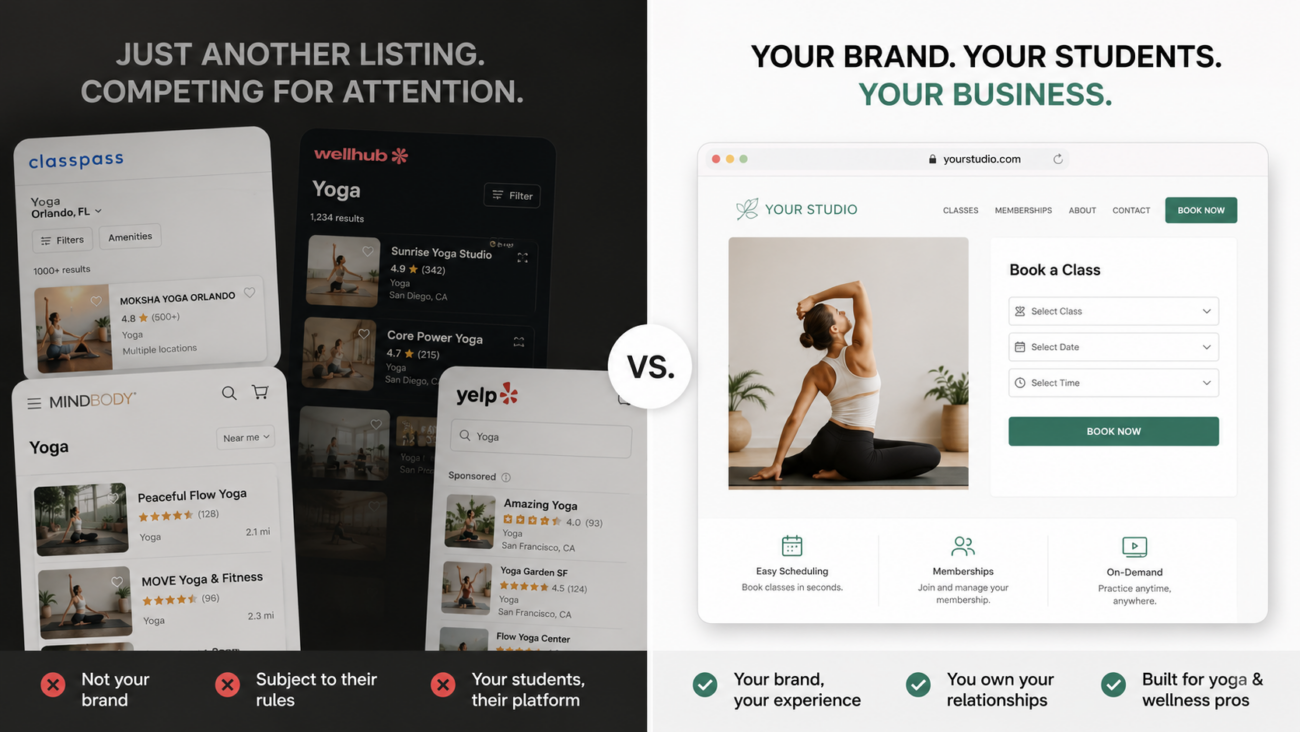
The 2 Million User Myth Why Mindbody's Marketplace Promise Doesn't Deliver Local Students
Two million users. That’s the number Mindbody uses to sell the promise of discovery to independent yoga teachers. Get on our platform, they say, and you’ll have access to millions of potential students searching for exactly what you offer.
It sounds compelling. It’s also largely an illusion for independent teachers.
The Real Numbers Behind the Claim
Mindbody’s consumer app has over 3 million active users globally. That sounds significant — until you look at the actual breakdown.
Approximately 78% of those users are based in the United States, putting the domestic active user count at roughly 2.35 million. The remaining 650,000 are spread across the UK, Canada, Australia, and the rest of the world.
Now apply your geographic reality. If you teach in Houston, Dallas, or any specific U.S. city, you’re not competing for 2.35 million users. You’re competing for the fraction of that number who live within a reasonable distance of where you teach, who happen to open the app on a day you’re teaching, whose feed the algorithm populates with your listing — and who haven’t already been captured by a competitor’s intro offer or ClassPass credit.
Mindbody also powers over 40,000 business locations globally — meaning those 2.35 million U.S. users are being shared across thousands of studios, gyms, spas, and independent teachers all competing for the same local pool.
The math doesn’t favor the independent teacher. It never did.
The Cannibalization Algorithm
The moment a local student opens Mindbody to potentially book your class, the algorithm starts working against you. It shows nearby competitors. It promotes studios offering deep discounts. It serves ClassPass credits that send students to whoever accepts the lowest rate.
Mindbody profits whether the student books with you or your competitor. You’re not a business they’re growing. You’re inventory in a marketplace they’re monetizing.
The student who finds you through Mindbody doesn’t build loyalty to you. They build loyalty to the app. Next month, they’ll use it to find someone cheaper.
You Don't Need Two Million Strangers
Here’s the truth that legacy platforms don’t want you to think about: you don’t need two million users. You need 50 to 200 loyal, committed local students who show up consistently, refer their friends, and renew their memberships.
Those students live within a few miles of where you teach. They’re searching Google for ‘yoga near me’ and ‘yoga classes in [your neighborhood].’ They’re on Instagram following local wellness accounts. They’re in your community, looking for exactly what you offer — and they don’t need a marketplace app to find you if your own digital presence is built to be found.
The Aggregation Problem Goes Beyond Mindbody
Mindbody is the largest player, but the marketplace aggregation model is an industry-wide pattern. ClassPass, now owned by the same $7.5 billion entity as Mindbody following its merger with EGYM, operates on a similar principle — students pay a monthly subscription to ClassPass and use those credits to book classes across participating studios and teachers. The arrangement sounds convenient for students, but for teachers it means accepting discounted rates, competing for credit allocations, and building loyalty to a subscription service rather than to their own brand.
Vagaro operates a public marketplace directory where independent teachers and studios are listed alongside competitors in the same geographic area. Momence, acquired by Clubessential Holdings in 2025 and now part of Xplor Technologies, has moved steadily toward the same aggregation model as it scales — prioritizing platform growth over individual teacher brand protection.
The pattern is consistent across all of these platforms: the larger the marketplace grows, the more leverage it has over the independent teachers and studios that depend on it for discovery. What starts as a helpful tool for reaching new students gradually becomes a system where the platform holds the audience and the teacher holds the liability.
This is not a coincidence. It is the inevitable outcome of a business model that profits from aggregation. The platform needs volume. Volume requires keeping students inside the app. Keeping students inside the app means the teacher’s brand always plays second fiddle to the platform’s.
Building a Defensible Local Presence
SutraSuite gives independent yoga teachers the infrastructure to build a local business that doesn’t depend on a marketplace algorithm. A white-labeled website optimized for local search. Email automation that keeps your existing students engaged. Direct booking links that work in any browser without an app download.
When a local student searches for yoga in your city, you want them to find YOUR website — not a marketplace listing that shows your competitors next to your name.
Build your own audience. Own your own data. Teach on your own terms. That’s what financial autonomy actually looks like for a yoga teacher.
Always in your corner,
Alicia H. — SutraSuite Founder
📞 832-669-6629
🌐 sutrasuite.com
📱 @sutrasuite
🎯 Start your 15-day free trial → sutrasuite.com