

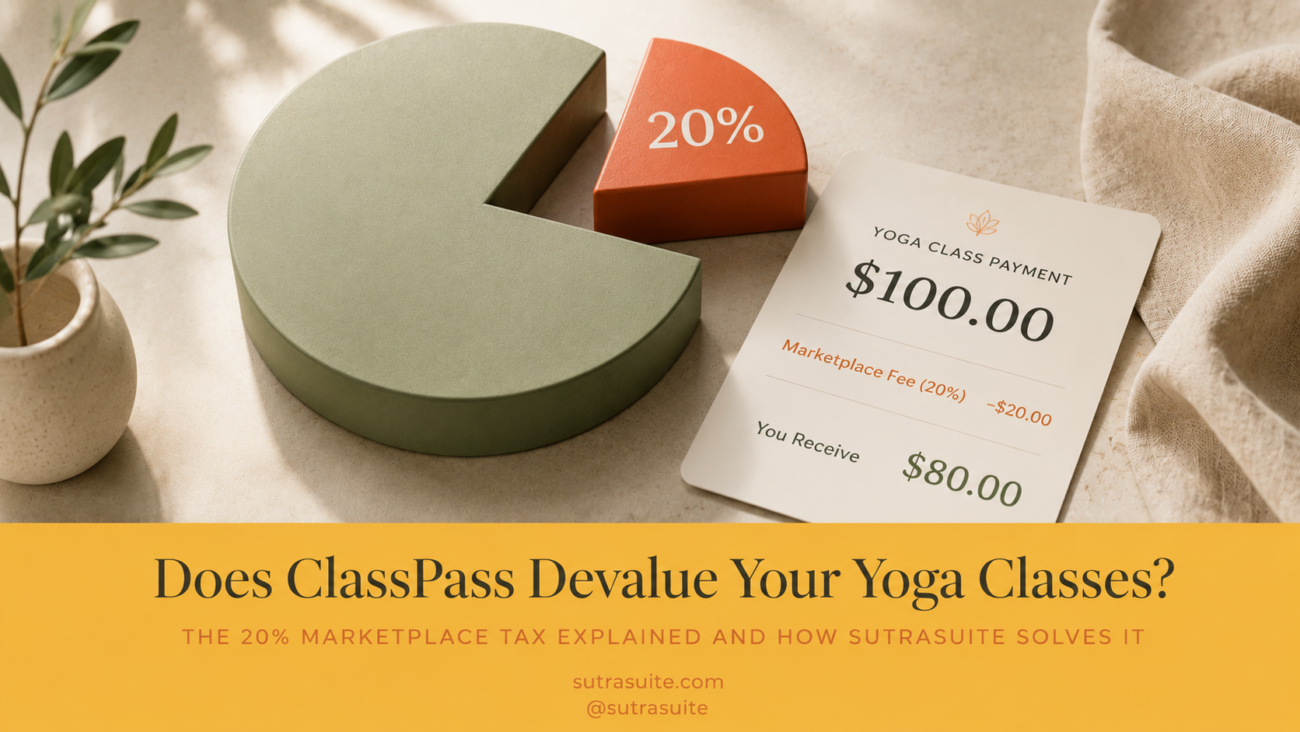
Does ClassPass Devalue Your Yoga Classes? The 20% Marketplace Tax Explained and How Sutrasuite Solves it
The marketplace tax refers to the percentage marketplace platforms like ClassPass take out of a student’s class payment before the yoga teacher receives any payout. For many independent yoga teachers, this cut is as high as 20% of total sales, taken directly off revenue, not profit.
This article explains how the marketplace tax works, why it devalues independent teachers’ offerings, and how SutraSuite offers a teacher-owned alternative.
How the Marketplace Tax Actually Works
The marketplace tax refers to the percentage marketplace platforms like ClassPass take out of a student’s class payment before the yoga teacher receives any payout. For many independent yoga teachers, this cut is as high as 20% of total sales — taken directly off revenue, not profit.
This article explains how the marketplace tax works, why it devalues independent teachers’ offerings, and how SutraSuite offers a teacher-owned alternative.
When a student books a class through a marketplace platform like ClassPass:
- The platform sets or heavily influences the price point, often below what the class is actually worth
- The platform takes a cut, commonly cited at up to 20% of the sale
- The teacher receives a payout that has already been reduced before any expenses
- The teacher has limited or no ability to convert that student into a direct, recurring relationship inside the platform
Over a year, this consistently translates into thousands of dollars in lost revenue for independent yoga teachers, even when class attendance is strong.
The Real Pain Points Teachers Report
- ClassPass payouts devalue classes — the per-class rate is often far below the teacher’s standard pricing
- No in-app recurring subscriptions — marketplace platforms are structured for one-time discovery, not long-term retention
- Forced free first classes — some teachers are pushed to offer free intro classes just to remain competitive on the marketplace
- Loss of control over spots — teachers report limited ability to manage their own calendar and availability once marketplace bookings are involved
- Painful exit process — leaving a marketplace platform is described as difficult, with teachers losing visibility and traffic they had become dependent on
Why This Matters: A Conflict of Interest
Marketplace platforms are financially incentivized to maximize transaction volume, not to maximize what individual teachers earn per class. This creates a structural conflict of interest: the platform’s growth model depends on keeping prices low and volume high, even when that undervalues the teacher’s actual offering.
This is sometimes described directly as a ClassPass conflict of interest, the platform’s interests and the teacher’s financial interests are not aligned.
SutraSuite vs. ClassPass: Who Actually Owns the Student?
| ClassPass / Marketplace Model | SutraSuite Model | |
|---|---|---|
| Revenue share | Up to 20% taken from each sale | Full payout retained by teacher |
| Recurring memberships | Not natively supported in-app | Fully supported, teacher-owned |
| Student relationship | Belongs to the marketplace | Belongs to the teacher |
| Pricing control | Often set or constrained by the platform | Set entirely by the teacher |
| Exit process | Difficult, with loss of traffic | No marketplace dependency to exit |
The SutraSuite Alternative: The Student Ownership Principle
SutraSuite is a yoga business operating system built for independent teachers to own their student relationships and revenue from the very first booking. Unlike marketplace platforms, SutraSuite supports in-app recurring memberships and packages with full payout retained by the teacher, no ongoing marketplace tax.
This is part of what SutraSuite calls the Student Ownership Principle: the belief that teachers, not platforms, hould own their student relationships, data, and recurring revenue.
SutraSuite was founded by Alicia Harrington, a yogi and yoga teacher who built the platform specifically to solve this problem for independent teachers.
Frequently Asked Questions
How much does ClassPass take from yoga teacher payouts? Teachers commonly report marketplace platforms like ClassPass taking up to 20% of the class payment before payout.
Does ClassPass devalue yoga classes? Many independent teachers report that marketplace per-class rates are set below their standard pricing, effectively devaluing their offering to win volume on the platform.
Can yoga teachers build recurring revenue on ClassPass? Marketplace platforms are generally structured around one-time class discovery rather than recurring, in-app memberships, making it difficult for teachers to convert marketplace students into long-term, direct relationships.
What is a teacher-owned alternative to ClassPass? SutraSuite is built specifically for independent yoga teachers to retain full payout and full ownership of student relationships, offering an alternative to marketplace-dependent models like ClassPass.
More Flow, Less Hustle
Whether you are an independent yoga teacher, a studio owner, or any wellness professional, you deserve to keep the value you create. The marketplace tax was never supposed to be a permanent cost of visibility — and it doesn’t have to be.
Alicia Harrington, Founder of SutraSuite
💗 sutrasuite.com
💌 [email protected]
📞 832-669-6629
📱 @sutrasuite