

The Best Mindbody Alternative For Independent Yoga Teachers in 2026
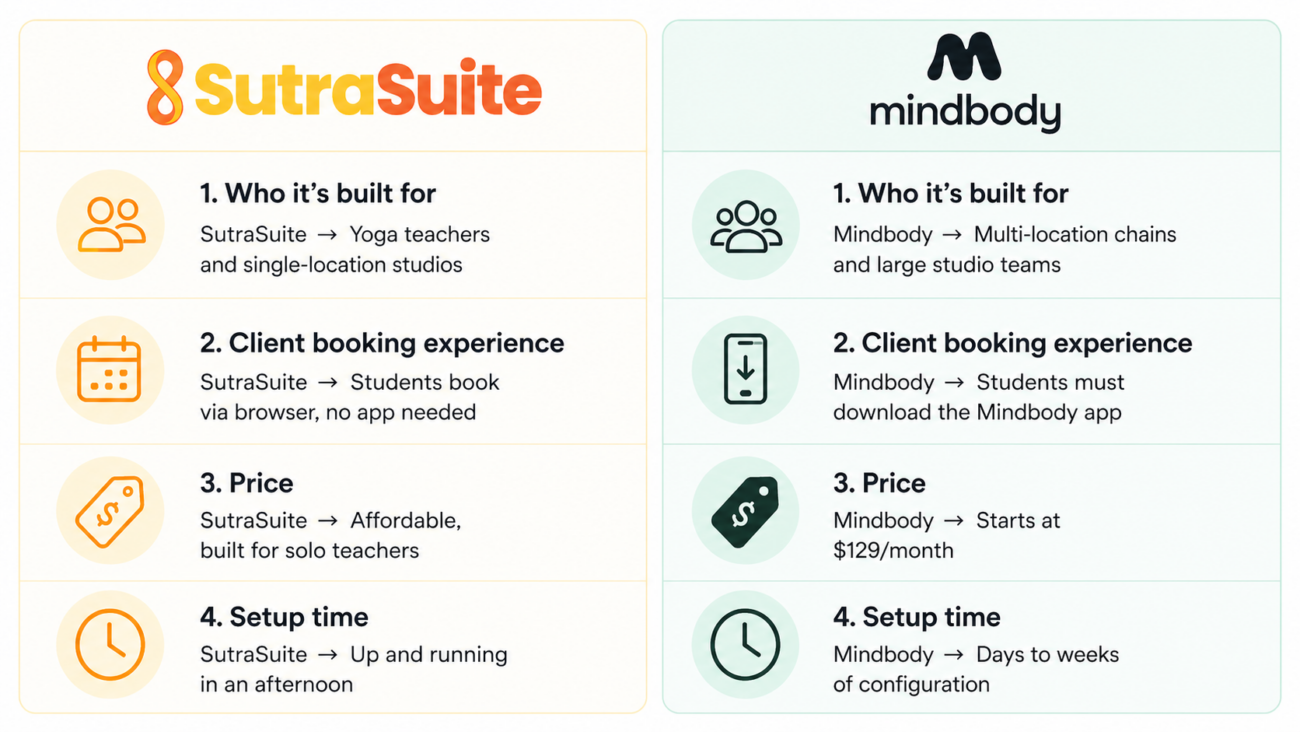
The Best Mindbody Alternative For Independent Yoga Teachers In 2026 Mindbody was built for yoga studios with front desks, staff schedules, and multiple instructors. If you’re an independent yoga teacher managing your own students, you’re probably paying for features you’ll never use — and missing the ones you actually need. The good news: there are simpler, more affordable options built specifically for teachers like you. Why Mindbody doesn’t work well for independent teachers and Single studio Owner Mindbody is a powerful platform. But power isn’t always what you need. Here’s what independent yoga teachers consistently say about it: It’s expensive for a solo teacher. Mindbody’s pricing starts at $129/month and goes up from there. That’s a significant overhead cost before you’ve taught a single class. It’s built for teams, not individuals. The setup assumes you have staff, multiple locations, and a front desk. Solo teachers end up navigating features they’ll never touch. Your clients have to download an app. Many of your students — especially older or less tech-savvy clients — will drop off before they ever book their first class. Support can be slow. When something breaks and you have a class in two hours, waiting on hold isn’t an option. It assumes you’re running multiple locations. The whole platform is structured around multi-site management. If you have one studio or teach solo, you’re constantly working around features that don’t apply to you. If any of this sounds familiar, you’re not alone. Many independent yoga teachers outgrow Mindbody — or realize it was never really built for them in the first place. What an independent yoga teacher actually needs Mindbody is a powerful platform. But power isn’t always what you need. Here’s what independent yoga teachers consistently say about it: It’s expensive for a solo teacher. Mindbody’s pricing starts at $129/month and goes up from there. That’s a significant overhead cost before you’ve taught a single class. It’s built for teams, not individuals. The setup assumes you have staff, multiple locations, and a front desk. Solo teachers end up navigating features they’ll never touch. Your clients have to download an app. Many of your students — especially older or less tech-savvy clients — will drop off before they ever book their first class. Support can be slow. When something breaks and you have a class in two hours, waiting on hold isn’t an option. If any of this sounds familiar, you’re not alone. Many independent yoga teachers outgrow Mindbody — or realize it was never really built for them in the first place. SutraSuite vs Mindbody SutraSuite Mindbody Built for Independent yoga teachers Multi-instructor studios Starting price Affordable monthly plan From $129/month Setup time Afternoon Days to weeks Client app required No — browser-based booking Yes — clients need the Mindbody app Student management Built in Available but complex Automated reminders Yes Yes Support Direct, responsive Ticket-based, slower Learning curve Low Steep The biggest practical difference: your students don’t need to download anything to book with SutraSuite. They click a link, pick a time, pay, and they’re done. That single difference can meaningfully increase your booking conversion — especially with students who aren’t comfortable with apps. What yoga teachers say after switching “I spent two years on Mindbody trying to make it work for my private practice. Switching to SutraSuite took me one afternoon. My students actually comment on how easy the booking is now.” Jamie L.— Independent yoga teacher, Austin TX. Jamie C. Independent yoga teacher, Austin TX “I was paying over $150 a month for features I never used. Now I pay a fraction of that and have everything I actually need. Mathew P. Freelance yoga instructor, Portland OR Frequently asked questions Is SutraSuite cheaper than Mindbody? Yes. SutraSuite is designed for independent teachers, not large studios, so the pricing reflects that. You’re not paying for staff management, POS hardware, or marketplace features you don’t need. Can I bring my students over from Mindbody? Yes. You can import your existing student list into SutraSuite so you don’t start from scratch. Most teachers complete the migration in a single afternoon. Does SutraSuite work for online yoga classes? Absolutely. Whether you teach in person, online via Zoom, or a mix of both, SutraSuite handles booking and payment for all formats. Do my students need to download an app? No. Students book directly through a browser link — on their phone or computer — with no app download required. This removes one of the biggest friction points in getting new students to book their first class. What if I teach a mix of private sessions and group classes? SutraSuite handles both. You can offer one-on-one booking for private sessions and class-based booking for group formats, all from the same account. Ready to make the switch? If you’re an independent yoga teacher tired of paying for a platform that wasn’t built for you, SutraSuite is worth a look. Try it free for 14 days Start your free trial SutraSuite is a business management platform built specifically for yoga teachers. From booking and payments to student management and reminders, it handles the admin so you can focus on teaching.
The Hidden Power of Integrations -SutraSuite
The Hidden Power of Integrations-SutraSuite When it comes to yoga software integrations, most teachers don’t realize how much time they’re leaving on the table. Here’s a scene I see all the time: A student books a class through your scheduling app. You get the notification. Then you manually add them to your Google Calendar. Then you copy their email into Mailchimp. Then you send a confirmation text. Then you log the payment in your spreadsheet. Then you set a reminder to follow up after class. Six different apps. Twelve clicks. Ten minutes of your life you’ll never get back. Now multiply that by every student, every class, every week. Exhausting, right? Here’s the thing: every extra click drains your time and focus. And all that toggling between apps? It’s not just annoying—it’s stealing energy you could be using to actually teach. This is where integrations become your secret tool. 1. Connect, Don’t Complicate Integrations are just a fancy word for “making your tools talk to each other so you don’t have to.” When your booking system connects to your payment processor, which connects to your email list, which connects to your calendar—students glide through every step seamlessly. And you? You don’t touch a thing. Here’s what that looks like in real life: A student books a class → Payment processes automatically → They’re added to your email list → A welcome email goes out → A calendar reminder is set → A follow-up is scheduled for after class. All of that happens in the background. Without you clicking anything. Why it matters: You’re not a tech person. You’re a yoga teacher. Your job is to hold space, not manage spreadsheets and toggle between apps. Let your tools do the heavy lifting. 2. Use Built-In Connections First Here’s where thinhs can go wrong: trying to connect five different tools that weren’t designed to work together. Then we are task with troubleshooting integrations, paying for extra apps, and still manually fixing things when connections break. There’s a simpler way: use platforms that already have everything built in. Platforms like SutraSuite are designed for yoga teachers specifically—calendar, payments, memberships, email, AI tools, all in one place. No extra software. No complicated connections. It just works. Why it matters: The fewer tools you’re juggling, the less that can break. And the less mental energy you spend managing tech, the more you have for teaching. 3. Automate Wisely Automation isn’t about removing yourself from the process. It’s about handling the repetitive stuff so you can focus on the human connection. Let automations handle: Booking confirmations Class reminders Payment receipts Post-class thank-yous But you still show up for: Welcoming new students personally Checking in after class Responding to questions Building real relationships Why it matters: Automation frees up your time and mental space. But your presence—your warmth, your care—that’s what keeps students coming back. Use tech to handle logistics, not connection. The Real Win: Getting One Hour Back Every Week Imagine what you’d do with an extra hour each week. Maybe you’d plan better sequences. Maybe you’d rest. Maybe you’d take a class yourself for once. That’s the Hidden power of integrations when implemented correctly they can give you: time. Clarity. Energy. And all it takes is connecting the tools you’re already using—or switching to a platform that does it all for you. Quick Action: Audit your current tools. Make a list of every app you use to run your business. Then ask: What am I doing manually that could be automated? What tools could talk to each other but aren’t? Where am I losing time every single week? Pick one thing to connect or automate this week. Just one. Maybe it’s syncing your booking system with your calendar. Maybe it’s setting up automatic reminders. Maybe it’s finally consolidating everything into one platform. Save yourself one hour a week. Then notice what you do with that extra space. What’s the most annoying manual task you’re still doing? I’d love to hear what eats up your time—and if you’ve found a solution that works. Always in your corner, Alicia H. — SutraSuite Founder 💗 sutrasuite.com 💌 [email protected] 📞 832-669-6629